

By Kathy Beardsley
Genesis 2:
8 ¶ And the LORD God planted a garden eastward in Eden; and there he put the man whom he had formed.
9 And out of the ground made the LORD God to grow every tree that is pleasant to the sight, and good for food; the tree of life also in the midst of the garden, and the tree of knowledge of good and evil.
10 And a river went out of Eden to water the garden; and from thence it was parted, and became into four heads.
11 The name of the first is Pison: that is it which compasseth the whole land of Havilah, where there is gold;
12 And the gold of that land is good: there is bdellium and the onyx stone.
13 And the name of the second river is Gihon: the same is it that compasseth the whole land of Ethiopia.
14 And the name of the third river is Hiddekel: that is it which goeth toward the east of Assyria. And the fourth river is Euphrates.
At one time or another through the ages the speculation of where Eden and its garden were located has been explored. A geographical debate that we will probably not know the answer to until we are with the Lord. Places suggested thus far include: Armenia (west of the Caspian Sea), Media, near Damascus, Israel, Southern Arabia and Babylonia. It is also suggested that most authorities agree the probable site to be in the land of Shinar (or Babylonia) because of the tremendous fertile ground watered by an abundance of streams and it is the only place in the Mesopotamian tract in which one river parts into four arms (there are actually more than four). A deeper study reveals to accept that assessment some factors must be overlooked.
- Many of the speculations seem to be based more so on the two biggest rivers of the four named (Euphrates and Tigris a.k.a. Hiddekel) rather than all four together, and that Eden had to have existed along the route of one or both of them if not at the place deemed as the beginning—the one river between the junction of adjoining Euphrates and Tigris rivers and the northern coast of the Persian Gulf.
The overlooked facts here is that since the Pison and Gihon rivers were notable enough to mention that they compassed whole lands, why are they not depicted on maps as being in the same region as the two biggest rivers? Moreover, the Euphrates and Tigris rivers join and deposit into the Persian Gulf they do not begin there. If this was the starting point it would mean the Gulf water (which is not fresh water) is the main source and the rivers would have to flow northward, or northwest. If this is so, the smaller streams branching off would have to flow north as well. Of the fairly large number of northward flowing rivers around the world the Euphrates and Tigris are not among them.
- The use of post flood maps without considering the preflood possibilities has contributed, for the most part, to one way of thinking—that the rivers, lands and natural elements i.e. gold, bdellium and onyx stone are solely in the southern portions of what was then known as Assyria.
Keeping in mind there is no post flood map that is completely accurate, information that was used by others to suppose the approximate location of Eden to be in the southern region of Assyria can likewise be used with deductive reasoning to show that it is not i.e. the first point. The information we gleam can only be a rough estimate and we must consider the fact it is unlikely that a flood of that magnitude would leave the topography exactly as it was; newly created rivers and streams and so forth. However, certain details can be evidence to point us in the right direction.
Though gold did exist in the southern region of Assyria, there is nothing to say it didn’t also exist in the north. In fact, gold does exist in the northern regions of modern day Turkey (then called Armenia). If there is gold in this present day then it is safe to say there was gold in the days of Eden. One could further assume that there was bdellium (an aromatic tree gum resin) and onyx stone also since the three are mentioned together. These three elements, we are told in Genesis 2:11, 12 existed in the land of Havilah (the Havilah before the flood).
- The lands of Cush (Hebrew for Ethiopia) and Havilah, named for Noah’s descendants, are believed to be in the southern regions on either side of the Euphrates and Tigris rivers thus, the Pison and Gihon rivers must be in those areas as well as they are described as compassing the whole lands of Cush and Havilah.
Let me say first that “compasseth the whole land” (vv. 11, 13) doesn’t necessarily mean completely surround them. It also means “borders.” It is more probable that the Pison and Gihon rivers bordered the whole lands of Havilah and Cush.
The overlooked fact is the lands in the north before the flood had names that were adopted and used later. Because everything changed from preflood to post, the significance and meanings of “Havilah” and “Cush” before the flood, if they indeed had a meaning, could have changed as well. Noah was five hundred years old when he began having his sons Gen. 5:32 and he was six hundred years old when he was told to enter the ark with his family Gen. 7:6. The sons had wives but no children at that point for there were only eight people that entered the ark Gen. 6:18; 7:13. It was well after the flood that Ham named one of his sons Cush who then had a son named Havilah, and Shem’s second great grandson was named Havilah. Regardless of whatever land was occupied before entering the ark, Noah’s grandsons Cush and Havilah did not have lands in the south named after them until long after the flood and they were grown.
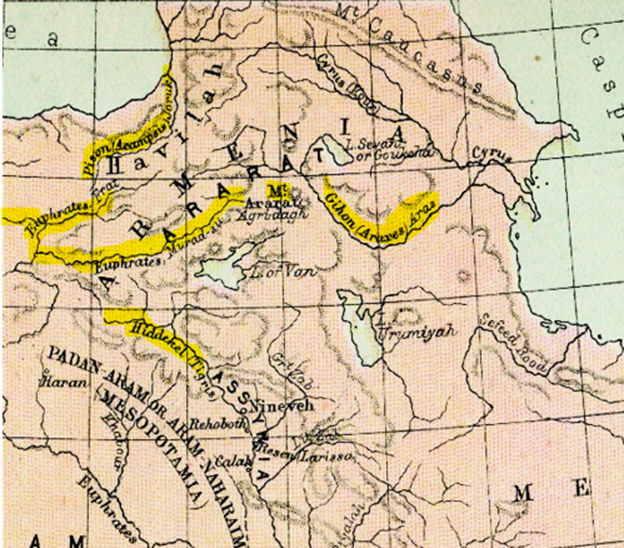
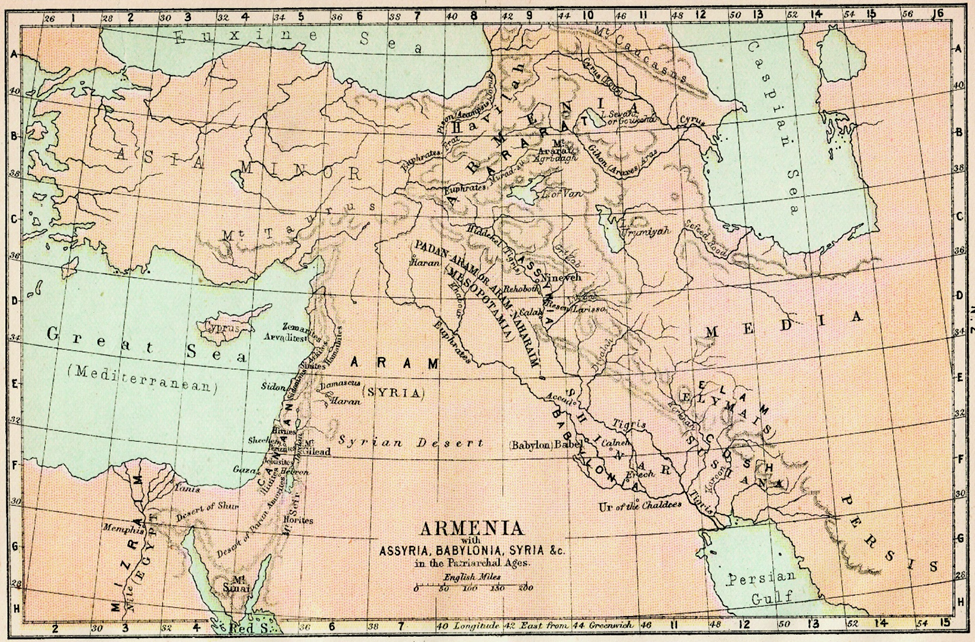
Going back to the very beginning, you can see on the old map provided (the only one I found that is the most accurate given the information provided) that all four rivers are named in Armenia/Ararat. Mt. Ararat is in the midst of them and that is where God chose to settle the ark with all of its inhabitants. The heads of the rivers are in the north thereby the flow of them ultimately run south. It is not difficult to believe that in the same area where life began (somewhere in the plains of Ararat), the LORD God began again.
 Truth with Snares!?
Leave a comment